


By Paul Poos, Teamlead & Senior Consultant, Dynamics4Business, December 11, 2025
In the spirit of AI
AI is evolving faster than any technological shift we’ve seen in recent decades. Whereas just last year organizations were mainly experimenting with Copilot or ChatGPT for small, isolated tasks, we are now on the brink of a new phase: AI that doesn’t just assist, but actively participates.
During Directions 2025, one thing became clear: AI will not simply be another tool in your toolbox — it will become a full-fledged part of your business processes. And as with any major change, the organizations that start now will soon take the lead. In this blog, we take a closer look at that next phase: agentic AI. What does it mean? How does it change business processes? And, more importantly, how do you prepare your organization for it?
The three phases of AI adoption, where does your organization stand?
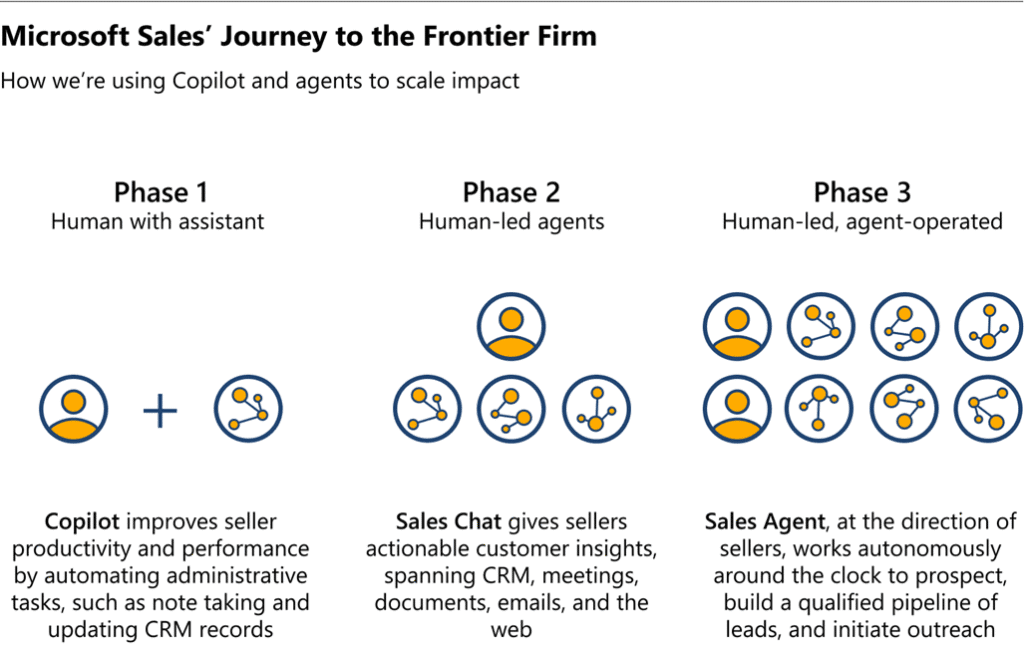
Microsoft describes the development of AI within organizations in three distinct phases:
Phase 1: Personal assistants
Copilot in Word or Excel, ChatGPT and Gemini to write or analyze faster. Practical, useful and approachable. This is where most organizations are today.
Phase 2: AI as a colleague
An agent becomes a team member: performs tasks within the context of your business - within Business Central, Power Platform solutions, within your workflows, with your data. They take work off your hands, but also make choices, ask for confirmation and explain why they are doing something.
Phase 3: Autonomous agents
An agent independently orders materials, schedules service visits, sends invoices or provides customer updates. Many companies are still in the experimental phase here, but the foundations are already in place and Microsoft is investing in them heavily.
The mechanic-agent: a case that makes everything clear
An example that we have developed ourselves is the mechanic-agent. This case shows well how AI transforms from digital assistant to digital colleague.
Phase 1: assistant
A mechanic uses Copilot to retrieve instructions. Useful, but only reactive.
Stage 2: Colleague
The agent actively supports:
- Reviews previous service visits
- Recognizes common problems
- Automatically finds matching documentation
- Suggests follow-up steps
Phase 3: autonomous
The agent orders required materials, schedules appointments in the system, assigns the appropriate technician and notifies the customer. This makes for much less administrative work.

What organizations can already do with this today
Many companies think AI with this kind of intelligence is still a long way off. But three crucial building blocks are already available:
- Standard agents in Business Central Such as the Sales Order Agent and Payables Agent, including human-in-the-loop controls.
- Ability to build custom agents From January, custom agents in Business Central will be available in public preview. Currently we are already realizing agents with Microsoft Copilot Studio.
- MCP Server as a connecting layer Allows AI systems to understand what is happening in Business Central.
Organizations starting pilots now are discovering where they can make processes smarter, faster and safer.
What this means for your organization
Agentic AI shifts roles:
- For planners: record less, resolve more exceptions
- For mechanics: less administration, more customer contact
- For service departments: less switching, more insight
- For finance: less manual work, more control
- For IT and business owners: less customization, more standardization
AI makes organizations more efficient - but it starts with discovering what it can do for your processes.

In conclusion
The future of AI is not abstract or complicated. It is already here. The question is not whether organizations will start using it, but when. The organizations that start today will have a head start tomorrow.
Wondering what agentic AI can do for your organization? We'd love to think with you, from initial idea to concrete use case. Visit us, meet us.